Showing posts with label The Decline. Show all posts

Saturday, November 07, 2009

An Overview of "The Decline of African-American Theology"

This year at The Gospel Coalition conference, I had the privilege of doing an overview of The Decline of African-American Theology: From Biblical Faith to Cultural Captivity. In the talk, I tried to accomplish four things:

1. Provide a brief biblical basis for writing a book like The Decline, a book that critically examines the theological positions of professing Christians writers and theologians. We briefly looked at Colossians 2 for support.

2. Provide an overview of the book's methodology and limitations.

3. Give a general overview of the African-American theological starting point as characterized by writers in the 1750s to early 1800s, who were largely Calvinistic, then work through historical turning points in the theological history.

4. And a few thoughts on the way forward: including correcting the revisionist history and bad theology out there, a call for more writers contributing to this field, recover the Bible to make it functionally central in the African-American church, recovering a high view of God and the recovery of the gospel, and recovering the purity and centrality of the local church as "the colony of God left here to beam out the gospel and to organize its life around the gospel".

Take a listen and let me know what you think.


Related Posts:


Comments Elsewhere:


Pick Up "The Decline" Here:

Thursday, September 24, 2009

Critiquing "The Decline"

Vincent Bacote, Associate Professor of Theology at Wheaton College, has published a kind and helpful critique of The Decline of African American Theology. Bacote's review is an example of the kind of charitable discussion, disagreement, and nuancing that I hoped the rather blunt critique in The Decline would be met with. So, it was a joy to read even as the author being critiqued. Thank you, brother Bacoste.

Bacote thinks that the "postmodern" era that concludes each chapter needed definition earlier in the book. I agree. Fair critique.

He also thought very important historical figures were so lightly treated as to appear insignificant in the story line. The omission of some figures is owing more to the book's methodology than to oversight or cherry-picking. Because I wanted to work with original sources, persons in their own words, certain historically key figures were omitted. To my knowledge, for example, almost nothing of Richard Allen's preaching ministry survives to be examined. He was committed to extemporaneous preaching, which means the founder of the first African-American denomination may be studied as a historical and sociological figure, but not very well studied as a theological figure. We await someone like Bishop D.A. Payne before we're able to look closely at an AME leader's theological positions. So, this is a weakness in the work but also a legacy of the history. A more complete tome might include more fragmentary comments from such figures.

Only two points in Bacote's critique missed the mark, in my opinion. First, I don't think it's accurate to say that I "chose to forgo any engagement with the major African American denominations. How can one assess African American theology without making much reference to the Church of God in Christ, the National Baptist Convention, the African Methodist Episcopal (A.M.E.) Church, and many others?" The book engages with Elias Camp Morris, the first president of the National Baptist Convention, who left a fair collection of sermons and addresses. Also, I've already mentioned the book's coverage of Bishop D.A. Payne of the A.M.E. Church. Payne is prominent in a number of chapters, and is arguably the denomination's first reformer exercising considerable theological influence on that group.

If I were to write a revision of The Decline at some point, I would like to spend more time thinking about Mason and others from the C.O.G.I.C tradition. As Bacoste points out, it would be helpful to not leave the reader thinking Pentecostal and Charismatic are one flat movement. Featuring Azusa Street and William Seymour so prominently inadvertently creates that impression, but it's not what I hold.

Secondly, Bacote finds it "dubious" that I would suggest a regulative principle for worship as part of how the decline might be reversed. Practically, every Christian body that takes the Bible seriously has at least some form of "regulative principle" in play. In some way or another, the Bible serves as rule for faith and conduct, even if there is variety in how the rule plays out or gets defined. That seems inescapable to me. Yet, I don't want folks to think that the book reduces church reform to an application of the regulative principle. Certainly much more than a regulative principle is needed, and I hope The Decline offers some suggestions to that end.

I'm thankful for Bacote's review. Read The Decline and read his review. May a thousand conversations bloom.

Related posts:
Why Write "The Decline of African American Theology"?
The Legacy of the African American Church: Faith
The Legacy of the African American Church: Justice
Can the Predominantly African American Church Be Reformed?

Thursday, April 16, 2009

Discussing "The Decline" on Iron Sharpens Iron

It'll be a privilege and a joy to join Chris Arnsen on his radio show, Iron Sharpens Iron, today and tomorrow at 3pm Eastern. We'll be discussing The Decline of African American Theology. If you're in the NY area, please tune in and join the discussion. Or join us online as well.

Tuesday, April 01, 2008

Oprah and Jesus on the Importance of Belief

Oprah Winfrey has started an online "school" for teaching people about the works of Meister Tolle called "A New Earth." Someone on Godtube had put together a short video of some of the online study's content and some commentary of their own.

It's a horrifyingly dark set of teachings. During the video, Oprah includes a word of personal testimony including how the idea of a jealous God repulsed her.


"God... in the essence of all consciousness... isn't someting to believe. God is. God is. And God is a feeling experience, not a believing experience. And, in fact, if your religion is a believing experience... if God for you is still about a belief, then it's not truly God."
--Oprah Winfrey

So much for her earlier comment in this video, where she defended the idea that there is not one true way to God but that all paths lead there. All paths except belief in a personal, sovereign God who reveals himself in the Word of God and calls all men everywhere to repent and believe.

"For God so loved the world that He gave His one and only Son, that whosoever believes in Him shall not perish but have eternal life. For God did not send his Son into the world to condemn the world, but to save the world through him. Whoever believes in Him is not condemned, but whoever does not believe stands condemned already because he has not believed in the name of God's one and only Son. This is the verdice: Light has come into the world, but men loved darkness instead of light because their deeds were evil. Everyone who does evil hates the light, and will not come into the light for fear that his deeds will be exposed. But whoever lives by the truth comes into the light, so that it may be seen plainly that what he has done has been done through God."
--Jesus Christ (John 3:16-21; emphasis in the original)

Obviously, Oprah's online "school" is unhealthy stuff. It's cross-denying and therefore leads only to death and eternal woe. But I don't want to just beat up on Oprah.

One thing I'm thankful for from this video is that Oprah helps us preachers to think a bit more carefully about our audience. There are no doubt many in the pew who would find teaching about a jealous God repulsive, and yet they've not understood how God's jealousy for His own name is utterly unlike fallen human jealousy or how it is absolutely right that God infinte in every perfection be jealous for His name, that God's own zeal for His name is commendable in light of who God is. I'd love for Oprah to sit down with Piper and work though some of this! And I'd love to preach to my own people in a way that doesn't leave them at 20-something staggering away from the Lord because they're projecting themselves onto God.

Oh that the Lord would make me a preacher!

Wednesday, February 20, 2008

Review of The Decline

The brothers at The Christian Manifesto have posted a review of The Decline. I am grateful to God for their kind words, and join with them in their prayer that the book would help spark much needed reflection and discussion.

Monday, February 18, 2008

Discussing The Decline on Hip Hop Radio

Today I'm headed for the Bay area. Well, not really. I could wish I were. It's one of my favorite areas in the world. My wife and I vacationed there about once a year for several years.

Okay... enough free chamber of commerce plugs. The Lord has granted the privilege of speaking with Anita Johnson on "Hard Knock Radio" about The Decline. I'm looking forward to the interview; Hark Knock Radio is a drive time "talk show for the Hip Hop generation."

On their website you can find this list of recent guests and programs:

KRS-One, Russell Simmons, Saul Williams, Sarah Jones, Yuri Kochiyama, Al Sharpton, Mystic, Cornel West, Ben Harper, Tavis Smiley, Sista Souljah, Blackalicious, Congresswoman Barbara Lee, Dilated Peoples, Kool Moe Dee, Afrika Bambaataa, The Coup, Congresswoman Cynthia McKinney, Paris, Chuck D and Reverend Jesse Jackson to name a few.

Just reading the list of ol' school hip hop artists took a brutha back: KRS-One ("criminal minded, you've been blinded, lookin' for a style like mine? You can't find it..." or "1-2-3 the crew is called BDP. And if ya wanna go to da tip top, stop violence and hip hop, y-oh!"). Kool Moe Dee (pioneer of battlin'; do you remember his epic wars with LL Cool J?)

It irked my nerve
When I heard
A sucker rapper that I know I'll serve
Run around town sayin' he is the best
Is that a test?
I'm not impressed
Get real,you're nothin' but a toy
Don't ya know I'll serve that boy
Just like a waiter
Hit'em with a place of
These fresh rhymes and
Make sure that he
Pays the bill, and leave him standin' still
When he's had enough,hit him with a refill
And for dessert it won't be no ice cream
I'm just gonna splatter and shatter his pipe dream
Make him feel the wrath,beat him and laugh
Then when I finish them,
I'm gonna ask him
Who's the bests,and if he don't say Moe Dee
I'll take my whip and make him call himself Toby
Put him on punishment just like a child, then ask
How you like me now?

Okay... last one. Public Enemy. Sorta punk meets hip hop and urban rage and black nationalism. Probably the most politically in your face hip hop artists of their era. I wonder if you remember "Makes You Blind" on their '87 debut Yo! Bum Rush the Show? I can hear the royal jester of hip hop, Flava Flav, screeching in the background: "Ya blind baby. Ya blind from the fact that you can't see." This verse, in retrospect, is itself both sadly blind and appropriately critical:

UH PIMP OR PREACH
SAME THING
NUTTIN WORSE THAN A NEW BLACK CHURCH
LYIN ON THE TRUTH
CAUSE IT HURTS
BLACK MAN CAME FIRST
IN THE SWEET NAME OF JESUS
COST ME A DOLLAR
AT THE FLOW OF CREFLO
LIKE HOW THE HELL HE SUPPOSED TO KNOW

Now this is deeply sad because (1) the glory of the Savior is opposed; (2) his diagnosis of some preachers in the African American church as pimps (ouch!) could find justification; in 1987, long before many in the church world took notice, he called out Creflo Dollar in particular; and (3) he sees as clearly as any that the truth is in danger inside many black churches; now he'll have a different "truth" in mind, but he understands the bedrock issue.

Okay... for more edifying hip hop that brings you to the cross and the glorious Savior. Check out shai linne's new LP The Atonement (a review is here).

I'm not sure when the segment will air (it's a taped interview), but if interested you can find the show on kpfa.org. It airs daily at 4pm in the Bay area.

Wednesday, February 13, 2008

Bits and Pieces

This year I'm trying to think about evangelism, so this video caught my eye. I wonder how often my preaching looks like this example of extreme witnessing.

Also, Paul Crouse at Engaging Your World extended the priviledge of doing an interview on The Decline. As did Christian Manifesto.

Later today, Lord willing, it'll be a joy to discuss The Decline with Janet Parshall on Janet Parshall's America.

Tuesday, January 22, 2008

Discussing "The Decline" with Dr. Al Mohler

Yesterday, the Lord granted the great privilege of spending some time with my brother and friend, Dr. Al Mohler. We had a great time on his radio program discussing The Decline. I pray it's encouraging for any who decide to listen. Let me know what you think.

While you're there, check out the Mohler Show archives. A lot of worthwhile listening available there.

Wednesday, December 19, 2007

Radio Interviews

On Monday, the Lord granted the privilege of discussing The Decline on The Paul Edwards Show, God and Culture. Paul is always an engaging and provocative host. If interested, I pray the interview is edifying.

Last week, it was also a joy to join Pilgrim Radio's "His People" to discuss the book as well.

Friday, December 07, 2007

Blogspotting The Decline

I just wanted to give a word of thanks to the many friends and fellow-laborers, brothers and sisters in Christ, who have made some mention of The Decline of African-American Theology. I am grateful for your encouragements and support of this work.

Tim Challies offered a review at Discerning Reader.

Anthony Carter has been posting quotes and comments as he reads. See here and here.

Eric Redmond, that Man from Issachar, made some very generous comments about the book and posted a critique of Word-of-Faith churches and issues of social justice.

Lionel Woods at Black and Reformed Ministries writes, "I pray that this book will bring the Lord Jesus the glory He deserves in this world. He took on the wrath stored up for us, so that we can live in harmony with the creator. God is awesome and He has given us another nugget in this book. "

Jeff Fuller, one of the Reformed Evangelist team bloggers, has added The Decline to his list of reads for 2008.

TheoSource included a brief review of the book.

Lance Lewis plugged the book with these lines, "After reading it if you feel it’s worthwhile recommend it to friends, family, church members, Sunday school teachers, ministry leaders, assistant pastors and anyone else you think would benefit. While reading it please pray for the black church that the Lord will use this and other means to bring about a reformation for the sake of His savior and the praise of His glory."

Ronjour Locke at magnifyGOD mentioned The Decline in his reflections on reform in the African American church. A sample: "I long for my people to come to the Savior. But I fear that with liberation theology, prosperity theology, black Islam, and countless other ideologies, many blacks in America do not know the God of the Bible, nor do they know that Savior that has come to redeem them. God has uniquely designed the events of black history so that Christ would be exalted and the Gospel would spread. I long that the truth of the Gospel would be heard in black churches and spread throughout communities for the glory of God."

Thank you BaldJim for putting the book on your wish list.

Thanks Justin for mentioning the book.

The brothers at Grace Church Memphis call all to learn more about African American Christianity. They plug Carter's On Being Black and Reformed--which if you haven't read, you should do so immediately.

Laura hears the rumblings of reformation. I hear them, too, Laura!

If I missed giving you a shout, blame it on Google and Technorati :-). Actually, charge it to my head and not my heart. I am grateful to God for all of you who have given any thought or mention to The Decline. I pray the Lord uses your labors for His unceasing glory!
Thabiti

Monday, November 26, 2007

Why Write "The Decline of African American Theology"?

One question that people frequently ask authors is, "Why did you write this book?"

It's a fair and a good question. If you put something in print and work through the process of communicating, refining, and sometimes defending ideas, trying to get others to read and understand and possibly agree with you, you probably have some deep-seated reason that drives you to write. That reason for writing probably lies somewhere close to the author's heart. It's part of her or his outlook, a glimpse into their inner workings. And many readers want such a glimpse. They want to make contact not just with the ideas but with the person and motivation behind the ideas. At bottom, I think a lot of people are fairly ad hominem in our reading, especially of polemics.

I've searched for a good answer to the question, "Why did you write The Decline of African American Theology?" I wandered through a a handful of answers, all of them true but none of them quite right.

Tonight I watched an episode of Bill Moyers Journal, a PBS program that sometimes focuses on religious themes and ideas. It was an interview with African-American theologian, professor and author Dr. James H. Cone of Union Theological. Dr. Cone is the author of a number of books very influential among African-American academics and religious thinkers. He is the father of the Black Theology movement, an attempt to do theology with a liberationist ethic from the distinct vantage point of African American experience.

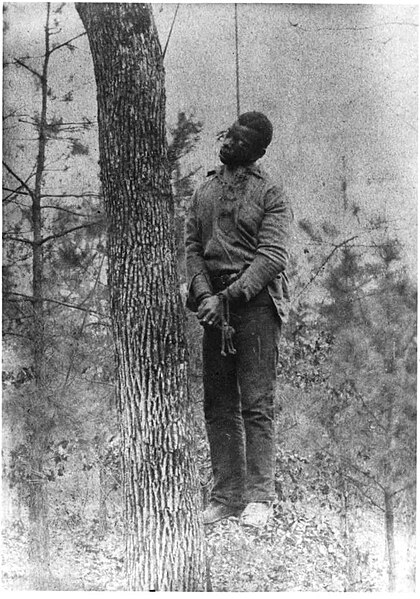
The Moyers interview was prompted by a 2006 lecture that Dr. Cone delivered at Harvard (watch). The lecture used American lynching as a metaphor for understanding the cross of Christ. The entire interview is worth watching if you're inclined. You'll see into the heart and thinking of perhaps the most influential African-American theologian in the last 50 years.

There is much that could be said about the interview. But rather than comment at length, pasted below are two brief exchanges between Mr. Moyers and Dr. Cone. I copy the comments because they finally helped me to say briefly what my motivation was for writing The Decline.

BILL MOYERS: And you say, "The cross and the lynching tree interpret each other. Both were public spectacles usually reserved for hardened criminals, rebellious slaves, rebels against the Roman state and falsely accused militant blacks who were often called black beasts and monsters in human form." So, how do the cross and the lynching tree interpret each other?
JAMES CONE: It keeps the lynchers from having the last word. The lynching tree interprets the cross. It keeps the cross out of the hands of those who are dominant. Nobody who is lynching anybody can understand the cross. That's why it's so important to place the cross and the lynching tree together. Because the cross, or the crucifixion was analogous to a first century lynching. In fact, biblical scholars-- when they want to describe what was happening to Jesus, many of them said, "It was a lynching."

And all I want to suggest is if American Christians say -- they want to identify with that cross, they have to see the cross as a lynching. Any time your empathy, your solidarity is with the little people, you're with the cross. If you identify with the lynchers, then, no, you can't understand what's happening. That in the sense of resistance-- what resistance means by helpless people. Power in the powerless is not something that we are accustomed to listening to and understanding. It's not a part of our historical experi-- America always wants to think it's gonna win everything. Well, black people have a history in which we didn't win. We did not win. See, our resistance is a resistance against the odds. That's why we can understand the cross.

**************
BILL MOYERS:
Do you believe God is love?
JAMES CONE: Yes, I believe God is love.
BILL MOYERS: I would have a hard time believing God is love if I were a black man. I mean, those bodies swinging on the tree. What was God?Where was God during the 400 years of slavery?
JAMES CONE: See, you are looking at it from the perspective of those who win. You have to see it from the - perspective of those who have no power. In fact, God is love because it's that power in your life that lets you know you can resist the definitions that other people are being-- placing on you. And you sort of say, sure, nobody knows the trouble I've seen. Nobody knows my sorrow. Sure, there is slavery. Sure, there is lynching, segregation.

But, glory, hallelujah. Now, that glory hallelujah is the fact that there is a humanity and a spirit that nobody can kill. And as long as you know that, you will resist. That was the power of the civil rights movement. That was the power of those who kept marching even though the odds are against you. How do you keep going when you don't have the battle tanks, when you don't have the guns? When you don't have the military power? When you have nothing? How do you keep going? How do you know that you are a human being? You know because there's a power that transcends all of that.
BILL MOYERS: So, how does love fit into that? What do you mean when you say God is love?
JAMES CONE:
God is that power. That power that enables you to resist. You love that! You love the power that empowers you even in a situation in which you have no political power. The-- you have to love God. Now, what is trouble is loving white people. Now, that's tough. It's not God we having trouble loving. Now, loving white people. Now, that's-- that's difficult. But, King -- you know, King helped us on that. But, that is a-- that is an agonizing response.

While I don't want to press it too far, I do think there are some interesting parallels between lynching and the cross that can help us better understand the gospel. But what God and the Cross are reduced to in this interview is appalling. No biblically recognizable cross and no glory.

The Decline of African-American Theology is a jeremiad, a long lament over a deep fall. Some will lament the decline, and others will lament The Decline. Of that I'm sure.

But after listening to Moyers and Cone tonight, I realized that I wrote the book because I am deeply sad. I'm sad about the state of the church in African American communities, and the very real eclipse of the gospel where African Americans gather and worship. And I'm sad because I love the Lord, His gospel, His people, and the nations who need the Lord, His gospel, and His people. The book isn't sad, I don't think, but its author is.

To be sure, my motives are alloyed with pride and some other things that need the sanctifying grace of Christ. But at bottom, I grieve that "my people perish for lack of knowledge" of the gospel of Jesus Christ. I pray this little book may be used by the Lord in the hands of good and faithful saints to turn the mourning of many into laughter.