Now that's just wrong. Can you say, "Road rage."
Heeerreee... kitty, kitty, kitty!
Now that's just wrong. Can you say, "Road rage."
Heeerreee... kitty, kitty, kitty!
 While we were at Bethlehem, my dear friend, brother, and fellow-laborer in the gospel and 9Marks, Jonathan Leeman, served the saints at FBC in a sermon from Colossians 3:1-17. I commend it to you for your soul's edification and your joy found in the gospel.
We are never done with the cross nor ever shall be. Its wonders will be always new and always fraught with joy. "The Lamb as it had been slain" will be the theme of our praise above. Why should such a name be given to him in such a book as the Revelation, which in one sense carried us far past the cross, were it not that we shall always realize our connection with its one salvation; we shall always be looking to it even in the midst of the glory; and we shall always be learning from it some new lesson regarding the work of him "in whom we have redemption through his blood, even the forgiveness of sins, according to the riches of his grace"? What will they who here speak of themselves as being so advanced as to be done with the cross say to being brought face to face with the slain Lamb, in the age of absolute perfection, the age of the heavenly glory?
You fool! Do you not know that the cross of the Lord Jesus Christ endures forever and that you shall eternally glory in it, if you are saved by it at all?
You fool! Will you not join in the song below, "To him who loved us, and washed us from our sins in his own blood"? Will you not join in the song above, "You were slain, and here redeemed us to God by your blood"? And do you not remember that it is "the Lamb as it had been slain" that "the seven spirits of God are sent forth into all the Earth"? (Rev. 5:6)
It is the Lamb who stands in the midst of the elders (Rev. 5:6) and before whom they fall down. "Worthy is the Lamb" is the theme of celestial song. It is the Lamb that opens the seals (6:1). It is before the Lamb that the great multitude stand clothed in white (7:9). It is the blood of the Lamb that washes the raiment white (7:14). It is by the blood of the Lamb that the victory is won (12:11). The book of life belongs to the Lamb slain (13:8). It was the Lamb that stood on the glorious Mount (14:1). It is the Lamb that the redeemed multitude are seen following (14:4), and that multitude is the first fruits unto God and unto the Lamb (14:4). It is the song of the Lamb that is sung in heaven (15:3). It is the Lamb that wars and overcomes (17:14). It is the marriage of the Lamb that is celebrated, and it is to the marriage supper of the Lamb that we are called (19:7, 9). The church is the Lamb's wife (21:9). On the foundations of the heavenly city are written the names of the twelve apostles of the Lamb (21:14). Of this city the Lord God Almighty and the Lamb (21:27, 22:1, 3) sum up this wondrous list of honours and dignities belonging to the Lord Jesus as the crucified Son of God.
Thus the glory of Heaven revolves around the cross, and every object on which the eye lights in the celestial city will remind us of the cross and carry us back to Golgotha. Never shall we get beyond it, or turn our backs on it, or cease to draw from it the divine virtue which it contains.
The tree--be it palm, cedar, or olive--can never be independent on its roots, however stately its growth and however plentiful its fruit. The building--be it palace or temple--can never be separated from its foundation, however spacious or ornate its structure may be. So, never shall the redeemed by independent of the cross or cease to draw from its fullness.
In what ways our looking to the cross hereafter will benefit us; what the shadow of that tree will do for us in the eternal kingdom, I know not, nor do I venture to say. But it would seem as if the cross and the glory were so inseparably bound together that there cannot be the enjoyment of the one without the remembrance of the other. The completeness of the sacrificial work on Calvary will be matter for eternal contemplation and rejoicing long after every sin has been, by its cleansing efficacy, washed out of our being forever.
Shall we ever exhaust the fullness of the cross? Is it a mere stepping-stone to something beyond itself? Shall we ever cease to glory in it (as the apostle gloried), not only because of past, but because of present and eternal blessing? The forgiveness of sin is one thing, but is that all? The crucifixion of the world is another, but is that all? Is the cross to be a relic, useless though venerable, like the serpent of brass laud up in the tabernacle to be destroyed perhaps at some future time and called Nehushtan? (2 Kings 18:4). Or is it not rather like the tree of life which bears twelve manner of fruits and yields its fruit every month by the banks of the celestial river? Its influence here on Earth is transforming. But even after the transformation has been completed and the whole church perfected, shall there not be a rising higher and higher, a taking on of greater and yet greater comeliness, a passing from glory to glory--all in connection with the cross and through the never-ending vision of its wonders?
Of the new Jerusalem it is said, "The Lamb is the light [or lamp] thereof" (Rev. 21:23). The Lamb is only another name for Christ crucified. Thus it is the cross that is the lamp of the holy city; and with its light the gates of pearl, the jasper wall, the golden streets, the brilliant foundations, and the crystal river are all lighted up. The glow of the cross is everywhere, penetrating every part, reflected from every gem; and by its peculiar radiance transporting the dwellers of the city back to Golgotha as the fountainhead of all this splendor.
It is light from Calvary that fills the Heavens of heavens. Yet it is no dim religious light, for the glory of God is to lighten to it (Rev. 21:23). Its light is "like unto a stone most precious, even like a jasper stone, clear as crystal... and there is no night there, and they need no candle, neither light of the sun, for the Lord God gives them light" (Rev. 21:11; 22:5). Yes, we shall never be done with the cross and the blood; though, where all are clean and perfect in every sense, these will not be used for purging the conscience or justifying the ungodly.
It is the symbol both a a dying and of a risen Christ that we find in the Revelation. the "Lamb as it had been slain" indicates both. But the prominence is given to the former. It is the slain Lamb that has the power and authority to open the seals; implying that it was in his sin bearing or sacrificial character that he exercised his right, and that it was his finished work on which this right rested and by which it was acquired. It is as the Lamb that he is possessed with all wisdom and strength--"the seven horns and the seven eyes, which are the seven Spirits of God" (Rev. 5:6); the Holy Spirit, or the Spirit of omniscience and omnipotence.
The Lamb is one of his special and eternal titles; the name by which he is best known in Heaven. As such, we obey and honor and worship him; never being allowed to lose sight of the cross amid all the glories of the kingdom. As such we follow him, and shall follow him eternally. As it is written, "There are thy that follow the Lamb wherever he goes" (Rev. 14:4).

whether you are starting out or have been doing this for a while, don’t make it into a burden. You will defeat your purpose if you treat this as a strict discipline. Your kids need to enjoy this, and if you include them and keep it simple at first, they will help you build it into more.Good counsel indeed. Read the entire post for more explanation and some additional resources. (HT: JT)
"The crisis in the Church of England," wrote Clive James in The Dreaming Swimmer, "is that too many of its bishops, and some would say of its archbishops, don't quite realize that they are atheists, but have begun to suspect it."
The "God of our many understandings" is a confused composite -- a very postmodern idol. Clive James is quite right about the theological crisis of unbelieving bishops - but you need go no farther than New Hampshire to find an example.
Customers inside the fast-food restaurant continued to order tacos and burritos as the couple sat Friday in an orange Taco Bell booth and exchanged vows.
Employees displayed hot sauce packets labeled with the words "Will you marry me?" They decorated the restaurant with streamers and balloons.
The bride wore a $15 hot pink dress and the entire wedding cost about $200. Several dozen guests looked on as the couple's friend, Ryan Green of Normal, administered the vows while wearing a T-shirt. He was ordained online.
The various sacrifices are all connected with the altar. Even that which was "burnt without the camp" was connected with the altar. It was no doubt carried forth without the camp and burnt with fire (Lev. 6:30, 16:27); but "the blood was brought into the tabernacle of the congregation, to reconcile withal in the holy place." "The blood of the bullock was brought in, to make atonement in the holy place." Their connection with the altar is sufficient of itself to show the truth of substitution contained in them, for the altar was the place of transference. But in each of them we find something which expresses this more directly and fully.
In the burnt offering we see the perfection of the substitute presented in the place of our imperfection, in not loving God with all our heart.
In the meat offering we have the perfection of the substitute, as that on which, when laid upon the alter, God feeds, and on which he invites us to feed.
In the peace offering we find the perfection of the substitute laid on the same altar as an atonement, reconciling us to God; removing the distance and the enmity, and providing food for us out of that which had passed through death; for "he is our peace."
In the sin offering we see the perfection of the substitute whose blood is sprinkled on the altar and whose body is burnt without, as securing pardon for unconscious sins--sins of ignorance.
In the trespass offering there is the same perfection of the substitute in his atoning character procuring forgiveness for conscious and wilful sin.
In the drink offering we have the perfection of the substitute poured out on the altar as that by which God is refreshed and by which we are also refreshed. "His blood is drink indeed."
in the incense offering we have the "sweet savor" of the substitute going up to God in our behalf; the cloud of fragrance from his life and death with which God is well pleased, enveloping us and making us fragrant with a fragrance not our own; absorbing all in us that is displeasing or hateful and replacing it with sweetness altogether perfect and divine.
In the fire we see the holy wrath of the Judge consuming the victim slain in the place of the sinner. In the ashes we have the proof that the wrath had been spent itself, that the penalty was paid, that the work was done. "It is finished," was the voice of the ashes on the altar.
In all this we see such things as the following: (1) God's displeasure against sin; (2) that displeasure exhausted in a righteous way; (3) the substitute presented and accepted; (4) the substitute slain and consumed; (5) the transference of the wrath from the sinner to his representative; (6) God resting in his live over the sinner and viewing him in the perfection of his substitute; (7) the sinner reconciled, accepted, complete, enjoying God's favor, and feeding at his table on that on which God had fed; on that which had come from the altar and had passed through the fire.
For that which satisfies the holiness of God cannot but satisfy the conscience of the sinner. God, pointing to the altar, says, "That is enough for me"; the sinner responds and says, "It is enough for me."

As you go into 2009, how are you praying? Got the nerve yet to ask God for what you really need and really long for and what would really display his glory in this God-denying world? Or are you settling for polite prayers that bore you and bore God and change nothing?
Would you like to be rid of this spiritual depression? The first thing you have to do is to say farewell now once and forever to your past. Realize that it has been covered and blotted out in Christ. Never look back at your sins again. Say: ‘It is finished, it is covered by the Blood of Christ'. That is your first step. Take that and finish with yourself and all this talk about goodness, and look to the Lord Jesus Christ. It is only then that true happiness and joy are possible for you. What you need is not to make resolutions to live a better life, to start fasting and sweating and praying. No! You just begin to say:
I rest my faith on Him alone
Who died for my transgressions to atone. (35)
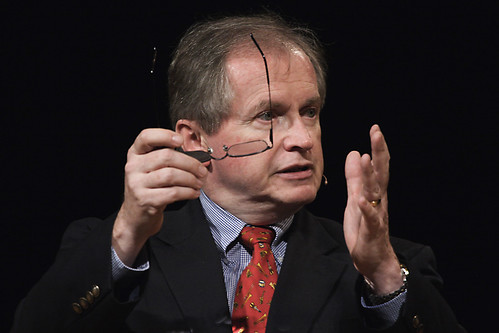
Countless volumes have been written on this subject, of course. Here I shall restrict myself to five observations.
First, preaching is more than the oral communication of information, no matter how biblical and divine that information may be. Rather, we should think in terms of what might be called "re-revelation." Across the centuries, God disclosed himself--he revealed himself--in great events (e.g., the burning bush, the exodus, the resurrection of Jesus); he disclosed himself supremely in the person of his Son. But very commonly he revealed himself by his words. Perennially we read, "The word of the Lord came to such-and-such a prophet." So when that Word is re-announced, there is a sense in which God, who revealed himself by that Word in the past, is re-revealing himself by that same Word once again. Preachers must bear this in mind. Their aim is more than to explain the Bible, however important that aim is. They want the proclamation of God's Word to be a revelatory event, a moment when God discloses himself afresh, a time when the people of God know that they have met with the living God. They know full well that for the Scriptures to have this revelatory impact the Spirit of God must apply that Word deeply to the human heart, so that preaching must never be seen as a mere subset of public oratory. Both the content (the Bible is God's Word) and the transformative empowering (the Spirit himself) transcend any merely mechanical view of preaching.
Second, to remain true to this basic understanding of what preaching is, the preacher must be committed to the primacy of expository preaching. We must take pains to debunk what many people think "exposition" and "expository" mean. They associate exposition with a style that takes not more than half a verse per sermon and casts around widely for every conceivable association, biblical and pastoral. Certainly that is one form of exposition, but that form is not the essence of the matter. Exposition is simply the unpacking of what is there. In a narrative text (e.g., 2 Samuel) or major epic (e.g., Job), fine exposition may focus on several chapters at once. If a sermon takes two or three short passages from disparate parts of the Bible and explains each of them carefully and faithfully within its own context, it remains an expository sermon, for it is unpacking what the biblical text or texts actually say. If we expect God to re-reveal himself by his own words, then our expositions must reflect as faithfully as possible what God actually said then the words were given to us in Scripture.
Third, there is an heraldic element in preaching. The Bible sometimes envisages other forms of oral communication, of course: we may be invited to reason together with the Lord (Is. 1:18), for instance, or enter into a dialogical confrontation with him (e.g., Mal. 1:2-8; Rom. 6:1-2). Yet in the oft-repeated "Thus says the Lord" of the Old Testament is an unavoidable heraldic element--an announcement, a sovereign disclosure, a nonnegotiable declaration. As ambassadors, we are tasked with making known the stance and intentions of our Sovereign; we do not have the authority to tamper with his position.
Fourth, preaching is never an end in itself. It is not an art form to be admired, still less mere high-flown rhetoric that so captures the audience's imagination that the content is of little importance. This is not to deny that artistry and rhetoric may be traced in sermons; rather, it is to keep ultimate ends in constant view. The faithful preacher will care little what folk think of his oratorical skills; he will care a great deal about whether he has faithfully represented the Master and his message. This includes a passionate commitment to make the Word wound and heal, sing and sting.
And that means, fifth, that we must study our own people, the culture of the people to whom we minister. Inevitably there are commonalities from culture to culture, but there are countless distinctives as well. To communicate effectively we must address the people of the time and place where God has placed us. This is a perennially urgent need in the thoughtful and faithful preacher....

 Posts
All Comments
Posts
All Comments


